The North American automotive aftermarket is undergoing a profound transformation. From part suppliers, distributors, to independent repair shops, our entire industry is experiencing what some call a passing trend, yet others call a complete restructuring. Many notable brands are already driving scale through recent acquisitions this year.
Private Equity Moves into the Aftermarket Space.
As vehicles become more technologically advanced, more expensive, and longer-lived, demand for replacement parts, warranty service, and specialized suppliers is surging. This combined with the average age of cars on the road increasing, creates demand and opportunity for large private equity companies to get involved, buying out smaller, less equipped aftermarket repair parts suppliers.
With modern vehicles containing advanced system features and hybrid drivetrains, today’s service providers must possess advanced diagnostic capabilities and access to specialized components. This is where smaller businesses struggle – by not having the financial means to keep up with the demands of an industry now requiring continual investment in training and upgraded tools. Smaller repair shops and part suppliers then begin to gravitate towards private equity arrangements.
Increasing Consolidation represents fundamental structural changes.
Acquiring specialty diagnostics firms, manufacturers of repair tools, and platforms for technical training allows aftermarket consolidators to meet the increasing complexity of repairs. Likewise, distributors that offer extensive SKU coverage for older models are emerging as vital strategic assets in developing scalable platforms.
Did you know? The average age of light-duty vehicles in the U.S. hit 12.6 years in 2024. Almost 40% of these vehicles fall into the aftermarket “sweet spot” of six to twelve years old—beyond OEM warranty coverage but still ideal for investing in high-quality repairs.
Vehicle affordability challenges push consumers toward extended ownership. These conditions make repairing rather than replacing the default choice for many owners. This behavior fuels demand for repair chains, remanufacturers, and extended warranty administrators — all targets of recent acquisition activity.
For M&A investors, this combination of aging vehicles and increasing complexity creates fertile ground. (admin, 2025)
Strategic and private equity (PE) buyers are responding by accelerating merger and acquisition (M&A) activity, consolidating a historically fragmented market into vertically integrated, technology-enabled platforms. This consolidation is not merely opportunistic; it reflects systemic shifts in the structure of the car parc, repair economics, consumer behavior, and competitive dynamics. (admin, 2025)
Skilled Labor Is a Driving Factor.
Another challenge facing independent repair businesses is the shortage of skilled labor. The North American aftermarket continues to experience a considerable deficit in qualified technicians. According to the TechForce Foundation’s 2024 Supply & Demand Report, there is an anticipated need for nearly 795,000 new automotive, diesel, and collision repair technicians between 2024 and 2028, primarily due to retirements, career transitions, and rising service demands.
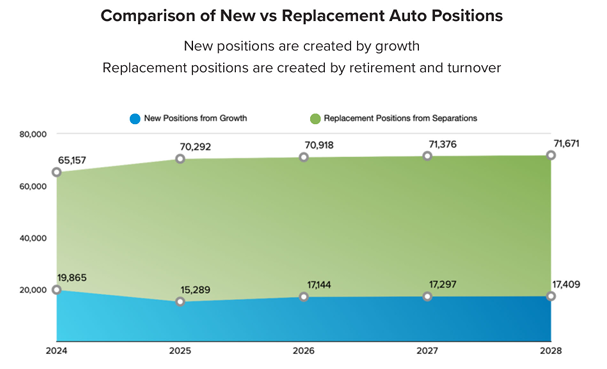
Consolidators are actively investigating automation, workflow optimization, and mobile service models as partial solutions to address labor shortages. This could greatly impact the industry, creating a new modern standard of how repair businesses are expected to operate. The benefits for consumers are clear: convenience, quick service, and minimized vehicle downtime.
From an M&A perspective, private equity interest continues to support consolidation across the aftermarket, particularly in tire dealerships and auto repair platforms. Investors remain focused on scalable platforms with strong technician depth, recurring demand, and add-on acquisition potential across tire, mechanical, collision, and quick-lube services (Automotive Aftermarket Industry Update Q2 2026, 2026).
What Can We Make of These Changes?
The automotive aftermarket is experiencing swift consolidation, driven by factors such as aging vehicles, increasing repair complexity, labor shortages, and private equity roll-ups. This shift is steering a historically fragmented sector towards larger, technology-driven platforms. However, part suppliers are still thriving.
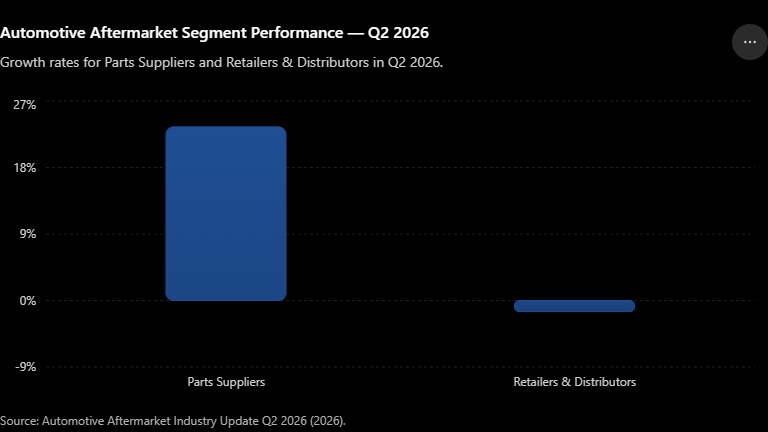
Despite a growing number of acquisitions within the market sector, parts suppliers led segment-level performance, achieving growth of 23.5% in the second quarter of 2026. Meanwhile, However, the Retailers & Distributors segment witnessed comparatively softer performance, with the segment closing Q2 2026 down 1.5%. (Automotive Aftermarket Industry Update Q2 2026, 2026).
Smaller independent retailers are feeling anxious as they observe current trends; however, industry change is always upon us, whether we are prepared for it or not. Ultimately, the key to thriving in any dynamic environment lies in adaptability and innovation. By embracing new technologies and strategies, businesses in the automotive aftermarket can continue to grow independently and meet the changing demands of consumers.
How Independent Business Can Still Thrive
By focusing on personalized customer service, niche expertise, and building strong community relationships, independent shops can carve out a unique position in the marketplace. Investing in continuous training for technicians can help bridge the skills gap and ensure high-quality service. Collaborating with educational institutions could also create a pipeline for new talent, ensuring a steady flow of skilled professionals into the industry.
Ultimately, while consolidation poses challenges, it also presents opportunities for independent businesses to innovate and thrive in new ways. By staying agile and open to change, these businesses can continue to play a vital role in the automotive aftermarket.
Sources:
admin. (2025, August 13). Consolidation, Complexity, and Critical Trends: How Non-Discretionary Repair Demand and Vehicle Evolution Are Reshaping the North American Automotive Aftermarket. Greenwich Capital Group. https://greenwichgp.com/2025/08/13/consolidation-complexity-and-critical-trends-how-non-discretionary-repair-demand-and-vehicle-evolution-are-reshaping-the-north-american-automotive-aftermarket/
Automotive Aftermarket Industry Update Q2 2026. (2026, July 30). KPMG. https://corporatefinance.kpmg.com/us/en/insights/2026/automotive-aftermarket-industry-update-q2-2026.html
Settle, G., & Demarzio, S. (2024). TechForce Foundation 2024 Supply & Demand Report. In techforce.org. https://techforce.org/wp-content/uploads/2024/12/2024-Supply-Demand-Report.pdf
2026 Joint Channel Market Size and Forecast by the Auto Care Association and MEMA Aftermarket Suppliers